

Untapped Opportunities Exist for Hong Kong Lenders to Drive Sustainable Growth
- Hong Kong consumers are increasingly leveraging their existing credit cards, presenting lenders with the opportunity to better maintain and gain loyalty, while seeking opportunities for sustainable growth
- Opportunities for growth exist amongst “new-to-product” borrowers in the personal loan market
- Traditional banks and money lenders are adapting their revolving lines risk management strategies to help manage deteriorating performance
Consumer demand for new credit cards in Hong Kong remained subdued towards the end of 2023 with consumers holding sufficient cards in wallet to meet their needs. However, growing credit card balances show that they are using their existing cards more, with lenders extending additional capacity to borrowers during the first quarter of 2024. These are some of the findings of TransUnion (NYSE: TRU) Hong Kong’s latest Industry Insights Report, which provides lenders with insights into the current trends driving the local credit market.
Credit card enquiries – a measure of consumers applying for new cards – decreased by 8% year-over-year (YoY) in Q4 2023, and origination volumes decreased by 20% YoY over the same period. However, during Q1 2024, outstanding balances increased by 8.6%, and average balances increased by 7.5%, indicating that consumers are increasingly using their existing cards in the current environment. Enquiry and origination data are reported a quarter in arrears to account for the reporting lag on new accounts opened.
“Consumers continued to leverage their existing credit lines, building balances to meet their consumption needs during the first quarter of 2024, and extending value within those cards’ loyalty programmes rather than seeking to add new cards to their wallets,” said Weihan Sun, principal of research and consulting for Asia Pacific at TransUnion. “This presents lenders with the opportunity to leverage rewards programmes and other retention strategies to attain or retain the position of consumers’ top-of-wallet card, particularly at a time when consumers are using their cards more.”
Money lenders are becoming increasingly dominant in Hong Kong’s personal loan market
Personal loan originations decreased by 8.7% YoY during Q4 2023, despite higher demand for this product as evidenced by a 4.0% YoY increase in enquiry volumes. At the same time, the average new loan amount issued increased by 2.9% YoY as lenders shifted a larger share of new originations to lower risk borrowers, who typically receive larger loan amounts. For personal loans, originations by the highest risk subprime1 borrowers tier fell 5.6%, while near prime grew by 4.8%. This shift in the borrower risk distribution on new loans might reflect a change in lender appetite as they focus on less risky segments due to a slight uptick in delinquencies for this product. Both account-level and consumer-level delinquencies (measured at 60 or more days past due) increased one basis point YoY in Q1 2024, though overall delinquency rates remain below the 1% level for both measures.
The report looked further at different segments of the personal loan market based on loan origination amounts: loans less than HK$150,000, loans between HK$150,000 and HK$300,000, loans exceeding HK$300,000. Each of these tiers displayed unique characteristics and are served by a different mix of lender types.
The lowest ticket value loan (less than HK$150,000) comprised 17% of active personal loans in Hong Kong in Q4 2023. At the same time, these smaller ticket loans represented 27% of recent originations and 25% of the consumer base holding personal loans – nearly two thirds (62%) of whom are Gen Z2. This loan category was mostly serviced by money lenders, who issued 80% of loan originations for the lowest ticket range in the same quarter, while only a 10% share was held by traditional banks and 10% by virtual banks. Within the lowest ticket range, 59% of personal loans were granted to subprime borrowers.
The largest share of outstanding personal loans (67%) was in the mid-size ticket tier (HK$150,000 to HK$300,000), with that tier representing 48% of new originations and 54% of the consumer base holding personal loans – 61% of whom are Millennials. In line with money lenders’ business strategy of attracting customers in this generation, two thirds (66%) of new loans in this middle-size tier were granted by money lenders, with less than one third (27%) being granted by traditional banks and 7% by virtual banks. Of these mid-size ticket loans, 18% were granted to subprime borrowers, a much lower share than for the small-ticket loan tier.
Larger loans, in excess of HK$300,000, were mostly dominated by traditional banks, with 88% of all originations in this tier in Q4 2023, with 11% being issued by money lenders and just 1% by virtual banks. These larger-ticket loans represented 25% of all personal loan originations in Q4 2023, with smaller shares of the total active loan market (16%) and of the consumers holding personal loans (21%). Only 2% of large ticket loans were granted to subprime borrowers, in line with the heavy lender concentration in this segment by banks, which tend to focus on better risk consumers.
Money lenders have actively targeted lower amount loans, aligned to their business model, and have built significant brand loyalty, as evidenced by the number of repeat borrowers choosing their products growing over time, leading to them winning a greater share of the small and mid-size loan tiers.
Chart 1: Origination Share of Repeat Borrowers
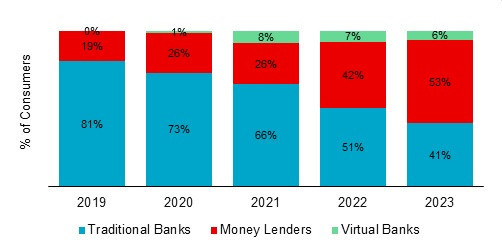
“The personal loans space, in particular for small- and medium-ticket loans, is increasingly dominated by money lenders, which represents significant repeat borrowing opportunities as these smaller-ticket loans tend to have shorter durations and turn over relatively quickly,” said Sun. “Furthermore, personal loans remain a sizeable organic new-to-product opportunity, with one in four originations driven by new-to-product consumers – those who have never opened a personal loan previously – as they seek liquidity to meet their growing consumption needs. These needs can include making large purchases or funding home improvements, especially as lower interest rates on personal loans hold more appeal for consumers paying off purchases over time than credit cards, which generally carry much higher interest rates.”
According to TransUnion’s Q1 2024 Consumer Pulse survey, 38% of Gen Z borrowers and 32% of Millennials are planning to apply for new credit or to refinance existing credit over the next year. At the same time, 39% of Millennials who intend to seek credit said that they intend to apply for a new personal loan in the next year, a view shared by 26% of Gen Z survey respondents. This renewed confidence in credit indicates growth opportunities for lenders to build and maintain loyalty, and further expand their existing relationships with consumers who are shopping around for the best interest rates and rewards, and the quickest turnaround time on approvals.
Deteriorating vintages in revolving lines demand continued monitoring
Revolving line of credit, as a product, is more concentrated within near prime and subprime consumers than for other credit products like credit card and mortgage. While higher delinquency rates are expected for these riskier borrowers, the report reveals that recent vintages of new revolving line originations by these riskier borrowers are performing worse, indicating an adverse selection phenomenon.
Table 1: Performance of revolving line originations at 12 months on book
Accounts 60 or more days past due (DPD), by risk tier | Originations from Q4 2019 | Originations from Q4 2022 |
Near Prime | 0.86% | 1.18% |
Subprime | 1.61% | 2.14% |
“More recent revolving line vintages for riskier borrowers have performed worse than pre-pandemic 2019 counterparts, likely because consumers are leveraging credit and balances have continued to build, potentially putting a strain on consumers’ wallets. However, we are seeing new lenders with different low-cost models entering the market who are more willing to cater to borrower risk segments that have previously been excluded, with the newer offerings accommodating a wider spectrum of consumers’ needs,” Sun said.
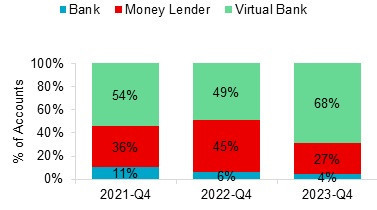
The revolving line landscape has shifted over the last few years, with virtual banks’ share of originations growing from 54% in Q4 2021 to 68% in Q4 of 2023. Over the same time, traditional banks’ share of these originations has declined from 11% to 4%, with money lenders having decreased from capturing more than one third (36%) of this market in 2021 to 27% in Q4 2023.
Chart 2: Origination distribution by lender type
“Lenders continue to seek new opportunities to engage with consumers in the market, which in turn has likely changed the borrower profile as more consumers in higher-risk credit tiers are now participating in products like revolving line,” he added. “Lenders need to be able to price for the additional risk at hand and monitor the early warning signs and indicators to enable greater predictability of delinquencies, and hence sustain smart growth for this product.”
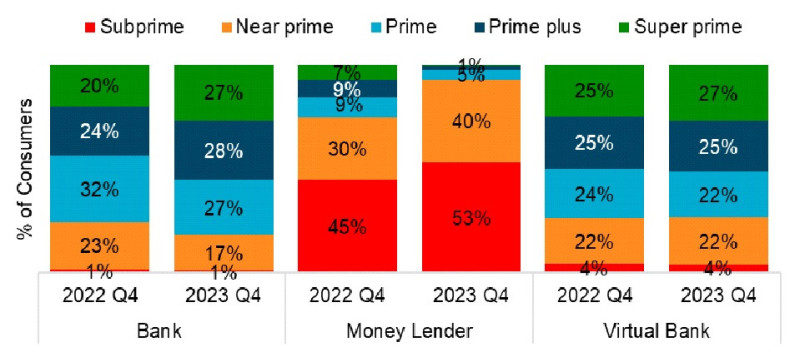
While the risk distribution among virtual bank originations has remained relatively constant over the last two years, it has shifted significantly among traditional banks and money lenders. Above prime borrowers have migrated away from money lenders, seemingly moving to traditional banks instead, which can often offer better interest rates to lower risk borrowers. At the same time, traditional banks have maintained their low exposure to subprime borrowers seeking revolving lines to 1% over that time and reduced their exposure to near prime consumers (from 23% to 17% over the same period), indicating a lower risk appetite.
Chart 3: Risk distribution of revolving line originations by lender type
Consumers continue to leverage their existing credit, leading to greater balance growth with increased spend in retail and travel – retail alone saw increases of 0.9% in January and 1.9% in February, with private expenditure rising 1% YoY in the first quarter3.
“In this context of continued growth in Hong Kong, untapped opportunities remain for lenders to find sustainable growth within their existing portfolios, along with building loyalty that will attract repeat borrowing with the same lender,” said Sun.


