

TransUnion Study Uncovers Significant Credit Opportunities for Hong Kong Consumers and Lenders Through Greater Wallet Diversity
- Three distinctive credit wallet profiles were identified among Hong Kong credit-active consumers, with most (83%) holding just credit cards in their wallets
- However, consumers can benefit from more diverse credit wallets, with different products meeting changing needs, such as taking out a promotion-interest rate personal loan to fund home improvements or travel
- Lenders can adopt a data-driven strategy to identify opportunities for enabling greater credit wallet diversity, guiding consumers to choose the credit products that best suit their needs
While the Hong Kong consumer credit market is often perceived as mature and saturated, a new study by TransUnion (NYSE:TU) has shown that most consumers only hold credit cards as their sole type of consumption credit product, excluding them from the benefits of more purposeful and diverse borrowing in response to differing financial obligations and needs.
Credit cards are well known and valued as a convenient and flexible credit tool for consumers to manage everyday spending and as a short term borrowing mechanism. However, many consumers may not understand or appreciate the various benefits of other credit products for a range of spending and borrowing needs. Consumers who periodically want to make larger purchases, such as travel or holiday spending, may benefit from the flexibility of a revolving line where they can benefit from repayments over a period that they are comfortable with.
As well, personal loans may be more appropriate for larger purchases such as new appliances or even home remodelling in Hong Kong’s increasingly accessible property market. Lenders often offer promotions on new personal loans, meaning that consumers could benefit from an initial three months at a lower interest rate, for example, followed by a fixed and predictable instalment plan.
The study, “Understanding Wallet Mix and Lender Segmentation,”1 set out to better understand Hong Kong’s distinctive credit wallet profiles and explore different needs and preferences across three segmented consumer credit wallet profiles. Presented at TransUnion’s 2025 Hong Kong Financial Services Summit, the study found that there are three main wallet types among Hong Kong consumers based on their holdings of consumption products, which include credit cards, personal loans and revolving lines:
- Basic spend wallet (83% of consumers) who hold only credit cards
- Flexible funding wallet (11%) who hold at least one credit card and just one personal loan or revolving line
- Extended credit wallet (2%) who hold at least one credit card and more than one personal loan and/or revolving line2
The remaining 4% of credit-active consumers with no credit cards in their wallets were not included in the study.
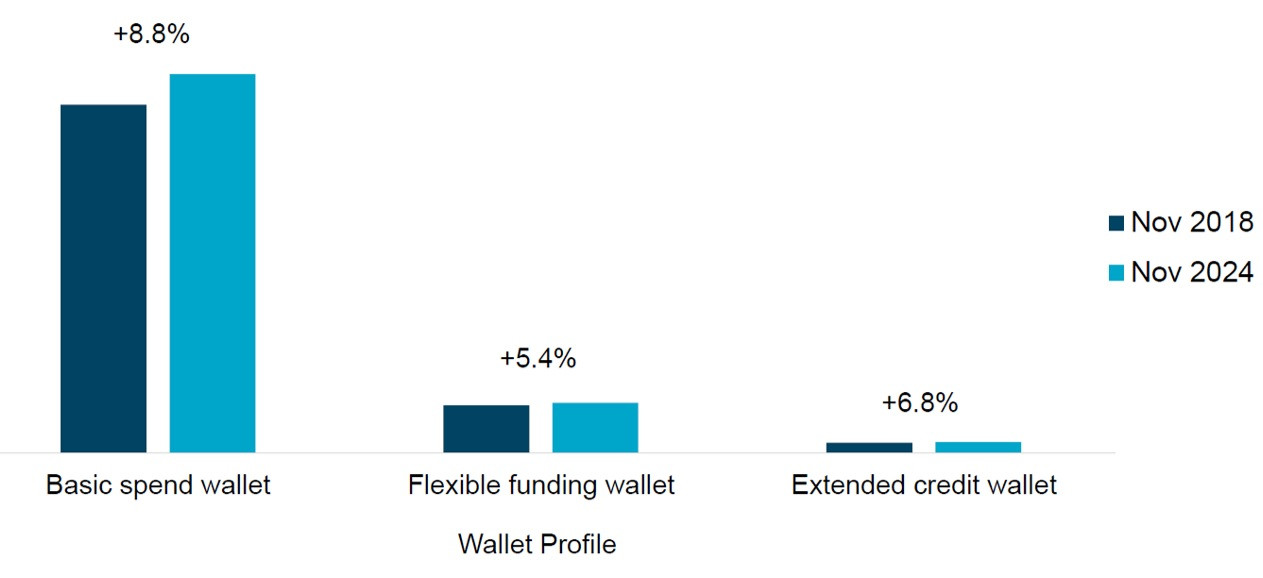
Amid a growing credit-active population in Hong Kong, the number of consumers across each of these three profiles has increased since November 2018 – the comparison point for the study that drew on November 2024 data. The fastest growth was observed among basic spend consumers, at 8.8%, outpacing flexible funding wallet (5.4%) and extended credit wallet (6.8%) consumers. This shows that new consumers entering the market are most likely to maintain that basic wallet profile, demonstrating consistent preference from consumers for a card-dense wallet rather than a diverse wallet.
Total Number of Consumers by Wallet Type
Source: TransUnion Hong Kong consumer credit database
“The study shows that Hong Kong is not nearly as mature a credit market as previously believed, with consumers tending to rely primarily on credit cards instead of adopting a broader range of consumption credit products to meet varied financial needs,” said Weihan Sun, principal of research and consulting for Asia Pacific at TransUnion. “However, a diverse set of credit solutions is available that enables consumers to manage their finances more efficiently – offering purpose-designed options tailored to specific purchases and repayment timeframes, while enhancing flexibility and reducing concentration risk on a single product, thereby strengthening financial resilience against unexpected shocks.”
Understanding flexible funding consumers’ preferences throughout their credit journey
Looking across the consumer credit journey, the study also examined consumers with a more diverse product mix – especially the flexible funding consumers with one type of non-credit card consumption product in wallet – who were most likely to seek additional credit. Based on the percentage of flexible funding consumers opening a new product over a one year period, they were most interested in new personal loans (4.4%), followed by credit cards (2.5%) and revolving lines (2.0%). Consumer preference for lender types for subsequent products also differed across credit products: 84% of flexible funding consumers who opened a subsequent credit card did so with a bank, while 89% of those who opened a personal loan turned to a money lender. For those who opened revolving lines, 55% chose money lenders for new origination, while another 43% turned to digital banks.
TransUnion’s study also found that flexible funding consumers were less loyal to an existing lender when they were originating a new credit card or revolving line – only 11% and 14%, respectively, opened a credit card or revolving line with an existing lender in wallet over the study period. However, their loyalty to lenders was much greater when seeking a personal loan: 58% of those who opened a new personal loan did so with a lender who was already represented in their wallet. Of those, the preferences were split relatively evenly between traditional banks and money lenders, at 54% and 46%, respectively.
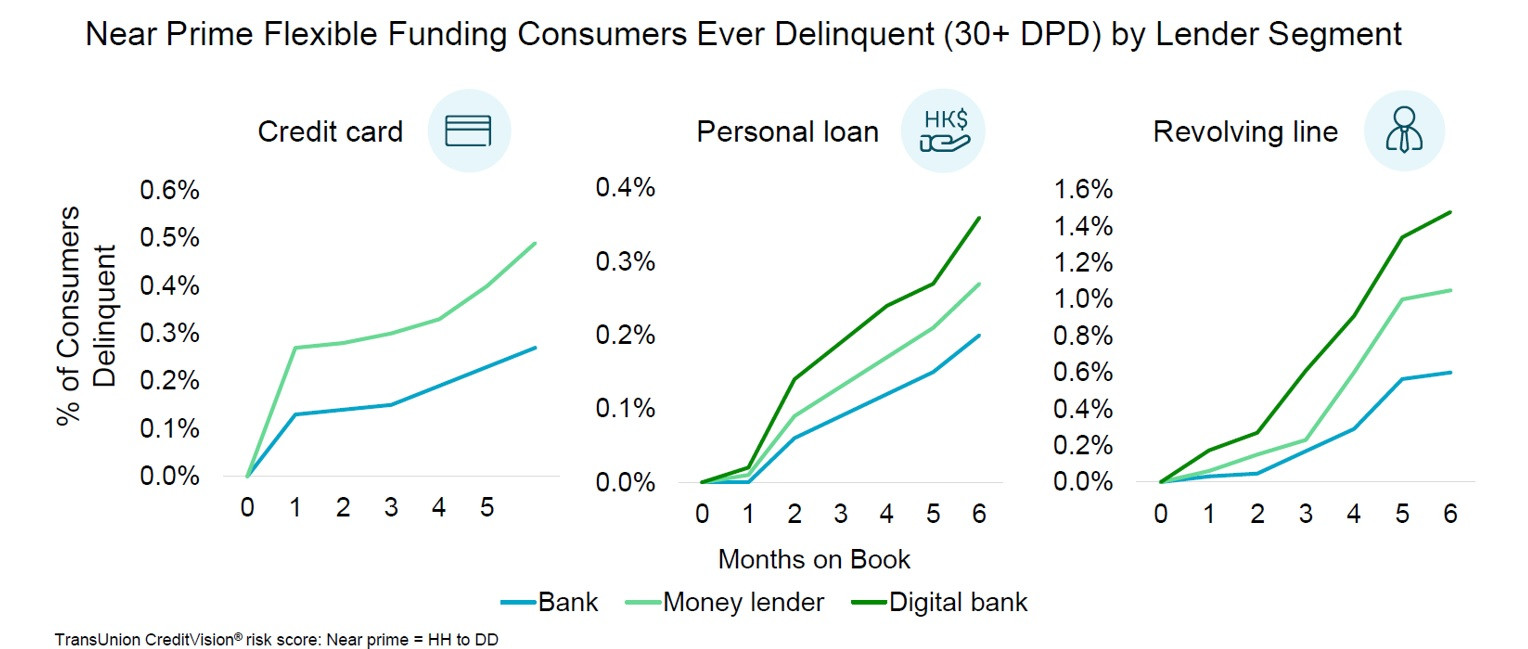
In terms of repayment performance on newly opened credit products, near prime flexible funding consumers tended to prioritise repayments for bank-issued products, with the percentage of new accounts delinquent (measured as 30 or more days past due) six months after account opening the lowest for the bank-issued product. Delinquencies for credit cards (0.27%), personal loans (0.20%) and revolving lines (0.60%) issued by banks, were typically lower than those of the same products issued by money lenders, at 0.49%, 0.27% and 1.05%, respectively. Digital banks also experienced higher delinquencies than traditional lenders.
Repayment Performance of Near Prime Flexible Funding Consumers on Newly Opened Credit Products
Source: TransUnion Hong Kong consumer credit database
The study also found that, when opening a new credit product, consumers prioritise repayments on the new product and tend to deprioritise payments on existing credit accounts. Among flexible funding consumers, the 30+ days delinquency rate for a new origination was 0.5% lower than for an existing account. This was true across all three wallet types, and remained consistent across lender segments too.
Wallet diversity unlocks growth for lenders while empowering consumers with broader credit choices
While Hong Kong’s credit market remains dominated by basic spend consumers, flexible funding consumers present a significant growth opportunity for lenders, as they are the most likely to originate new products. However, low lender loyalty and higher delinquencies among consumers with diverse wallet profiles highlight the need for targeted strategies. Lenders seeking to capture value in this credit environment should focus on strengthening customer retention and leveraging cross-selling campaigns. Implementing early default detection and monitoring tools into underwriting processes can also proactively address the higher risks across more diverse wallets.
Another key opportunity for lenders lies in promoting greater wallet diversity, which provides consumers with increased flexibility and choice to meet their unique financial needs, while unlocking untapped market potential.
“To unlock the full potential of Hong Kong’s credit market, lenders should focus on delivering personalised, purpose-driven credit solutions that not only address the current needs of consumers across the three credit wallet profiles, but also encourage the adoption of a broader range of credit products,” said Sun. “In turn, consumers can benefit from exploring a more diverse mix of credit options tailored to specific financial goals — moving beyond reliance on a single product to more targeted solutions that offer greater flexibility, different repayment options and improved risk management. Promoting wallet diversity is a win-win: it drives responsible growth for lenders while empowering consumers to take greater control of their financial wellbeing.”


