

Gig Workers Make Up 13% of Hong Kong’s Workforce: It’s Time to Rethink Credit Inclusion
- Nearly nine in ten (89%) of Hong Kong’s gig workers use gig work to supplement existing income from full-time employment
- Gig workers reportedly show similar credit risk and repayment discipline to those of the general population
- Gig workers express greater appetite for new credit products, but experience more difficulties when applying
A new study by TransUnion (NYSE:TU) challenges conventional perceptions of Hong Kong gig workers, revealing them to be responsible credit-active, credit-worthy consumers who require a different approach to risk assessment. Conducted in January 2026 among 500 gig workers across various industries, the study explores the scale and economic role of gig workers in Hong Kong and highlights opportunities for lenders to engage this growing segment.
The gig economy describes a work environment where individuals take on part-time, freelance or project-based jobs to earn an income, or extra income. Recently, the term has become closely associated with digital platforms that connect service providers directly to customers for tasks like delivery and ride-hailing.1
The study, “The Gig Economy in Hong Kong: Rethinking Credit Risk, Inclusion, and Market Opportunity”, to be presented at TransUnion’s annual 2026 Hong Kong Financial Services Summit, found that gig workers make up approximately 13% of Hong Kong’s workforce, with nearly nine in ten (89%) earning a salary or hourly wage from full-time employment in addition to their gig income. One in five (20%) gig workers earn at least half the median household income in 2025 (over HK$10,000 per month)2 through gig platforms. This workforce is predominantly Millennial (47%) and Gen X and older (31%)3, with a slight male majority (53%).
“Gig workers are a material and growing borrower segment who are often mistakenly perceived as having riskier, volatile income trends and inconsistent payment behaviours,” said Weihan Sun, senior director of research and consulting for Asia Pacific at TransUnion. “They face significantly higher friction, such as higher interest rates, lower credit limits and process complexity during credit applications as gig income is often excluded from formal assessments – but our findings show that perceptions about these consumers may be misplaced.”
Gig Workers Are Not Inherently Higher Risk
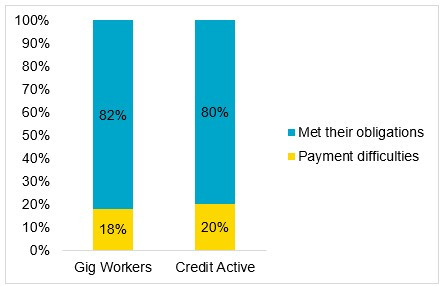
The study reveals that gig workers’ repayment behaviour aligns closely with the broader market, with no evidence of structurally higher risk. Among surveyed gig workers, 95% reported being in the prime and above4 credit risk tiers, compared to 90% of the general credit-active population. Their repayment behavior is also comparable to the broader market, with 82% meeting their payment obligations without difficulty, compared to 80% of the general population who said the same.
Chart 1: Hong Kong Gig Workers’ Credit Repayment Behaviour Compared to All in Hong Kong
Source: TransUnion Gig Economy Survey Hong Kong 2026
TransUnion Consumer Pulse Study Q1-Q4 2025
“This finding underscores that gig workers’ credit profiles and repayment behaviour are broadly consistent with the rest of the Hong Kong market,” said Sun. “This suggests that outcomes are more closely linked to income and borrowers’ individual characteristics than employment type alone.”
Gig Workers’ Appetite for Credit Exceeds the Broader Market, Despite Application Challenges
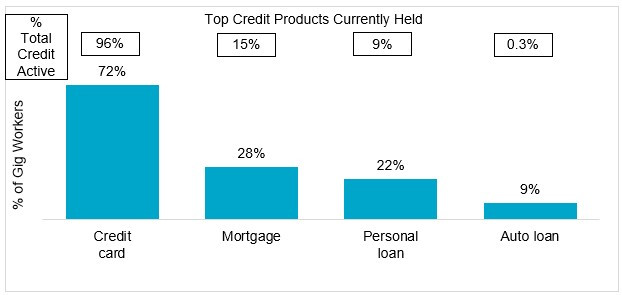
Gig workers demonstrate strong demand for credit, with 32% applying for new credit or refinancing in the past six months and 37% planning to do so in the next 12 months, compared to 30% of all credit-active consumers who have similar plans. They also exhibit higher uptake of several mainstream credit products: 28% hold mortgages (compared to 15% of the general population) and 22% have personal loans (compared to 9% of the general population). Notably, 9% of gig workers have auto loans, far exceeding the 0.3% observed across all credit-active consumers, likely because so many gig workers participate in transportation-based services.
Chart 2: Credit Products Held by Gig Workers, Compared to Total Population
Source: TransUnion Gig Economy Survey Hong Kong 2026
TransUnion Credit Information Services consumer credit database
However, despite their active participation in the credit market, gig workers face significant barriers when applying for new products. Across generations – Gen Z (44%), Millennials (48%) and Gen X and older (46%) – almost one in two reported difficulties applying for credit. Their challenges fall into two main categories. Under process-related barriers, nearly half (45%) cite unfavourable pricing and 41% point to complex application procedures. Under documentation-related constraints, 36% report being unable to provide required documentation such as pay slips, and 31% say fluctuating income led to questions or rejection.
“While gig workers show strong demand for credit products, the study indicates that many are not served to their full potential by lenders. This is despite the fact that a large share of gig workers already hold credit products and demonstrate positive repayment behaviours that are mostly in line with the performance of credit‑active consumers,” said Sun.
Gig Work Is Becoming a Durable Income Component
While often viewed as a temporary solution, gig work is increasingly becoming a sustained part of household financial planning and should be included in lenders’ credit risk and financial inclusion strategies. With 72% of gig workers not planning to leave this type of work in the near term, nearly half (44%) of surveyed gig workers plan to maintain their current gig hours, with almost one in five (18%) even intending to grow or expand their participation in the gig economy.
Workers value the flexibility (65% citing this as a benefit), earning potential (35%), and enjoyment of gig work (31%) the most. However, challenges remain, with reasons for low satisfaction with this earnings strategy including 43% feeling they do not earn enough, 33% reporting insufficient work opportunities, and 29% saying they must work excessively to cover expenses.
“With the continued growth of the digital economy, and ongoing needs to cope with high cost of living, gig workers represent a consistently expanding and high-potential borrower segment. The latest TransUnion study shows that many of these consumers are already credit-active and credit-worthy rather than inherently high risk,” said Sun.
“As gig work has become an ongoing supplementary income source for many, the wider credit industry has an opportunity to rethink how these consumers are evaluated and to broaden credit inclusion by refining how non-traditional income is assessed within existing risk and process frameworks. Adapting to consumers’ evolving profiles by including alternative data, for example, could better meet the needs of more Hong Kong consumers while driving sustainable, long-term growth for lenders,” he concluded.
1 Office of the Government Economist: An introduction to the gig economy
2 Census and Statistics Department: Report on Annual Earnings and Hours Survey
3 Generations are defined as follows: Gen Z, born 1995–2004; Millennials, born 1980–1994; Gen X, born 1965–1979; and Baby Boomers, born 1944–1964
4TransUnion CreditVision® risk score: super prime = AA; prime plus = BB; prime = CC; near prime = DD to HH; subprime = II to JJ


